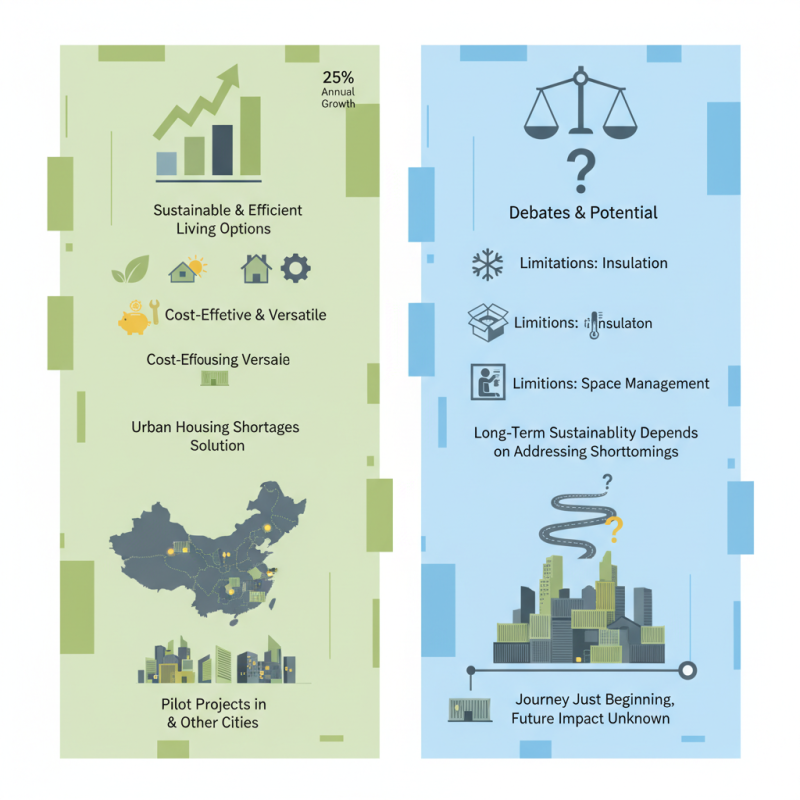
Container Houses are transforming the housing landscape in China. According to a recent report by GlobeNewswire, the market for these innovative structures is projected to grow by 25% annually. This growth reflects a rising demand for sustainable and efficient living options. Industry expert Dr. Steven Zhang states, “Container Houses offer a unique solution to urban housing shortages while promoting environmental sustainability.”
These structures are cost-effective and versatile. They can be customized for various uses, from residential homes to commercial spaces. Many cities in China are embracing Container Houses to address their housing crises. In places like Shanghai, local governments have started pilot projects to test their viability. However, limitations such as insulation and space management remain significant challenges.
As the industry evolves, the potential of Container Houses continues to spark debates. While they provide immediate solutions, long-term sustainability depends on addressing current shortcomings. The journey of Container Houses in China is just beginning, and their impact on future housing trends remains to be seen.
Container houses are emerging as a sustainable housing solution in China.
These homes, constructed from repurposed shipping containers, offer an innovative approach to urban living. According to the China Construction Industry Association, container homes can be built in up to 50% less time than traditional houses. This speed lowers labor costs and accelerates housing availability in urban areas.
Moreover, container houses are eco-friendly. The use of recycled materials significantly reduces waste. A report by the World Economic Forum indicates that construction accounts for over 20% of global carbon emissions. Container housing can minimize this impact, offering a more sustainable alternative. However, proper insulation and ventilation are crucial. Without these, energy efficiency can drop, leading to higher utility bills.
Tips:
Consider the location wisely. Urban areas might have zoning laws affecting placement. Also, think about community impact. A cluster of container homes might face resistance. It’s important to engage with local residents to foster acceptance and collaboration. The potential of container housing in China remains promising, but environmental and social measures must align for success.
In urban areas of China, container houses have emerged as a cost-effective solution for housing shortages. A report from the China Urban Construction Association highlights that building with shipping containers can save up to 30% on construction costs compared to traditional methods. This is largely due to the reduced material expenditure and shorter construction timelines. Containers are pre-fabricated units that can be quickly assembled, which reduces labor costs significantly.
Moreover, the durability and modular nature of these structures are appealing. They can withstand harsh weather conditions, and their reusability minimizes waste. According to industry studies, using repurposed containers decreases environmental impact by 50% compared to standard building practices. However, challenges remain. For instance, insulation and ventilation must be addressed to ensure comfort, which may increase initial investments.
The aesthetic appeal of container houses can also be a double-edged sword. While some designs are modern and attractive, others might blend poorly with traditional urban landscapes. Critics argue that aesthetics should not be sacrificed for cost savings. As cities grow, finding the right balance between economy, sustainability, and visual harmony is crucial.
This chart illustrates various cost-effectiveness metrics associated with building container houses in urban areas. The values represent a comparative index where a higher value indicates greater cost-effectiveness.
Container houses are gaining traction in China, particularly for their construction speed. According to a report by the China Academy of Building Research, container homes can be assembled in just a few days compared to traditional houses that may take months. This rapid assembly reduces labor costs and overall project duration.
The innovative design of container houses allows for pre-fabrication in controlled environments. This approach minimizes weather-related delays. In a study conducted by the National Building Materials Industry Technology Innovation Center, it was found that container homes can reduce waste by up to 30%. Efficient resource utilization is crucial in a country facing rapid urbanization.
However, some challenges remain. The supply chain for materials can sometimes cause inconsistencies in build quality. Additionally, not every region is equipped to handle this unique construction method effectively. Reflecting on these aspects can help stakeholders envision a balanced future for container housing in China.
| Feature | Description | Time Savings (Days) | Resource Savings (%) |
|---|---|---|---|
| Modularity | Container houses can be prefabricated in a factory setting, reducing on-site construction time. | 30 | 40 |
| Site Preparation | Minimal groundwork and site preparation required compared to traditional buildings. | 15 | 25 |
| Weather Resistance | Containers are built to endure harsh weather conditions, which can reduce repairs and maintenance time. | 10 | 15 |
| Transportability | Easy to transport, allowing for quick relocation and assembly at different sites. | 20 | 30 |
Container houses have gained traction in China for their flexibility and customization potential. These structures can be easily modified to suit diverse needs. Homeowners can design spaces that match their preferences and lifestyles. According to a report by the China Container Housing Association, the container house market is expected to grow by 15% annually over the next five years. This reflects greater acceptance and demand.
Customization is a key benefit. Container houses allow for various designs, including multi-story structures or compact single units. Architects can incorporate energy-efficient designs, enabling homeowners to save on utility costs. A recent study indicates that up to 40% of people prefer customizable housing options, highlighting the shift toward personalized living spaces. Container houses can include green roofs, large windows, and open layouts, enhancing overall living quality.
Tip: Think about the environment. Container houses utilize recycled materials, reducing overall waste. This is an excellent choice for eco-conscious individuals.
However, customization can pose challenges. Not all designs may meet local building codes. It’s essential to consult with a professional to ensure compliance. Another consideration is insulation for climate control. Proper insulation can mitigate energy costs, so take time to plan.
Container houses are emerging as a sustainable solution in China, significantly lowering waste. Research indicates that over 25 million containers are retired each year globally. Many of these containers end up in landfills or are abandoned, causing environmental concerns.
Transforming these containers into homes can mitigate this waste issue. A study from the National Bureau of Statistics of China highlights that container housing can reduce construction waste by up to 70%. These houses can be constructed quickly, usually within weeks, minimizing resource consumption.
The potential to repurpose existing materials is crucial. However, challenges remain. Building regulations can be unclear, and some projects face local opposition. It's essential to address these hurdles for widespread adoption. Container housing not only serves as an innovative solution but also encourages a circular economy, inviting communities to rethink waste and construction practices.
: Container houses can save up to 30% on construction costs compared to traditional methods.
They can reduce environmental impact by 50%, using repurposed materials and minimizing waste.
Homeowners can create spaces that fit their preferences, enhancing living quality and functionality.
Yes, not all designs meet local building codes, requiring professional guidance for compliance.
They utilize recycled materials, significantly lowering construction waste by up to 70%.
Some designs are attractive; others may clash with traditional urban landscapes, raising criticism.
These homes can often be built within weeks, which reduces overall resource consumption.
Yes, proper insulation is necessary for comfort and can help reduce energy costs.
Yes, the market is expected to grow by 15% annually, reflecting increased acceptance and demand.
Some projects may face local opposition or unclear building regulations, requiring careful planning.
Container Houses have emerged as a sustainable and cost-effective housing solution in China, addressing the challenges of urbanization and environmental concerns. These innovative structures utilize repurposed shipping containers, significantly reducing construction waste while providing affordable living options. The financial benefits make them particularly appealing, especially in urban areas where traditional housing can be prohibitively expensive.
In addition to their cost-effectiveness, Container Houses are known for their speed of construction, allowing for rapid deployment and efficient use of resources. Furthermore, their flexibility and customization potential enable architects and homeowners to design unique living spaces that cater to specific needs and preferences. Overall, the environmental impact of Container Houses contributes to a greener future by promoting recycling and sustainable building practices.

ZHONGHUI HOLDINGS