The global market for Sustainable Container House solutions is expanding beyond simple recycled steel boxes. Today, leading suppliers combine modular engineering, energy efficiency, and practical interior planning. Their projects may include compact studios, family homes, emergency housing, and hospitality units. Yet, appearance alone does not prove sustainability.
Architect Adam Kalkin, a recognized pioneer in container architecture, has described the shipping container as “one of the most incredible objects ever invented.” His observation reflects its strength, portability, and standardized dimensions. However, a responsible supplier must solve more than structural assembly. Buyers should examine insulation thickness, thermal bridging, ventilation, window performance, corrosion treatment, and material safety. A beautiful unit can still overheat in summer or lose energy during winter.
This guide compares top Sustainable Container House suppliers worldwide through an experience-based and technical lens. It considers manufacturing quality, customization, delivery capability, certifications, after-sales support, and demonstrated project performance. Supplier claims should be checked carefully. Some companies promote recycled containers while adding carbon-intensive finishes or inefficient systems. That contradiction matters.
Details reveal quality. Look for sealed roof joints, raised foundations, low-emission adhesives, and clearly documented electrical installations. Ask whether the supplier has completed projects in climates similar to yours. Review photographs, technical drawings, warranty terms, and maintenance records. Local building approval also deserves attention.
There is no perfect container home.
Each project involves trade-offs. This overview aims to make those trade-offs visible, helping readers identify reliable suppliers rather than choosing from attractive marketing alone.
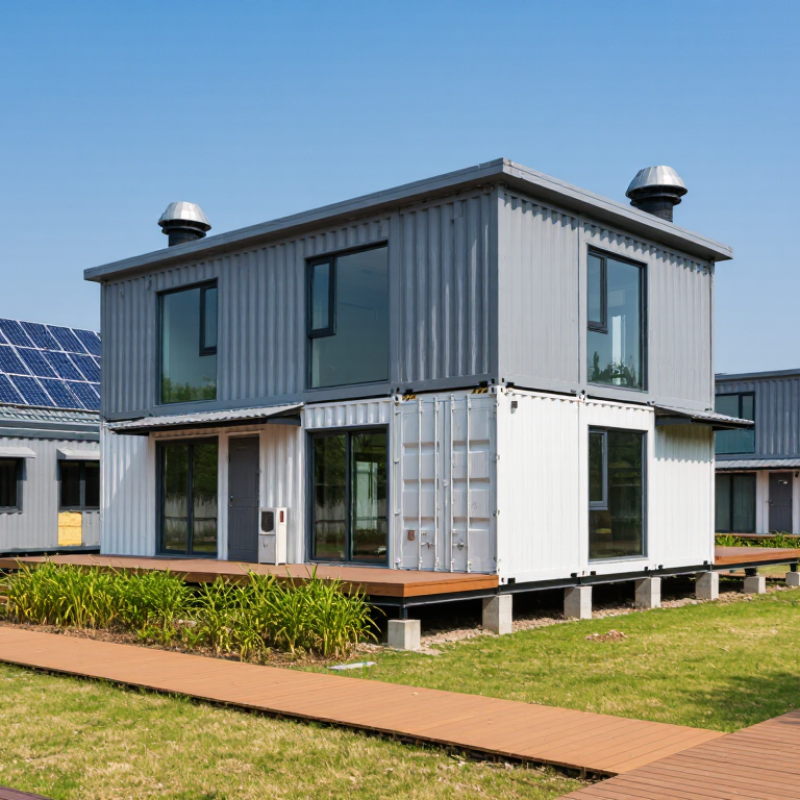
A sustainable container house supplier is defined by evidence, not recycled steel claims. The supplier should disclose material origins, refurbishment rates, coatings, insulation, and end-of-life plans. UNEP’s 2023 Global Status Report states that buildings and construction produced 37% of global energy-related emissions. The sector also consumed 34% of global energy. Efficiency matters. A credible supplier provides whole-life carbon assessments, product specifications, and measured thermal performance. Marketing language is not enough.
Look for independently verified Environmental Product Declarations, responsible procurement records, and an ISO 14001 environmental management system. ISO’s 2022 Survey recorded 529,853 ISO 14001 certificates worldwide. However, certification proves management processes, not a low-impact building. Ask for project-level evidence. Request U-values, air-leakage results, ventilation rates, water-saving fixtures, and construction waste records. Suppliers should explain performance in humid, cold, and hot climates. One standard design cannot fit every site. That is often overlooked.
Durability also defines sustainability. Suppliers should document corrosion protection, drainage details, fire-safety testing, repair access, and replacement-part availability. Verify claims through references, site inspections, and measurable warranties. The difficult question remains: is reusing a container better than using new low-carbon materials? Sometimes, no. Transport distance, heavy modifications, and poor insulation can erase the benefit. A responsible supplier admits these trade-offs and compares options using transparent life-cycle data. Imperfect evidence deserves cautious decisions.
A practical, brand-neutral framework for evaluating suppliers by measurable sustainability, safety, durability, and lifecycle-performance criteria.
| Evaluation Dimension | Verifiable Supplier Indicator | Realistic Sustainability Benchmark or Technical Fact | Recommended Evidence to Request |
|---|---|---|---|
| Container Source and Traceability | Clear documentation showing whether containers are new, one-trip, or used, together with ownership and chain-of-custody records. | A responsible supplier discloses the container’s age, previous cargo use, repair history, and destination market instead of presenting all units as equivalent. | Container identification records, inspection reports, purchase documents, and photographic condition surveys. |
| Structural Safety | Engineering review of the modified container frame, openings, reinforcements, lifting points, foundations, and connection details. | Removing side walls or end walls can change load paths; structural modifications should therefore be designed and checked by a qualified engineer under the applicable local building code. | Stamped structural calculations, connection details, engineering drawings, and site-specific foundation design. |
| International Container Standards | Verification that the original freight container was manufactured and maintained under recognized container requirements. | ISO 668 defines common freight-container dimensions, while the International Convention for Safe Containers establishes safety requirements for containers used in international transport. | Container plate information, valid safety approval documentation where applicable, dimensional records, and inspection history. |
| Material Reuse | Percentage of the existing container structure retained after conversion and transparent accounting of added materials. | Reuse can reduce demand for new structural steel, but extensive cutting, replacement, or added framing should be included in the project’s lifecycle assessment. | Material take-off, reuse percentage, cut-out management plan, and records showing how removed steel is recycled or reused. |
| Low-Impact Materials | Use of recycled, recyclable, rapidly renewable, locally sourced, or responsibly certified materials where technically suitable. | Material selection should consider embodied carbon, durability, maintenance needs, toxicity, recycled content, and end-of-life recovery rather than recycled content alone. | Environmental product declarations, recycled-content statements, responsible-sourcing certificates, and product safety data sheets. |
| Insulation and Thermal Bridging | Continuous insulation strategy for the steel shell, roof, floor, corners, openings, and service penetrations. | Steel is highly conductive, so a container home requires careful thermal-bridge control, condensation analysis, and compliance with the applicable regional energy code. | U-value calculations, condensation-risk analysis, insulation specifications, thermal-bridge details, and installation quality checks. |
| Operational Energy Efficiency | Energy model covering heating, cooling, hot water, lighting, appliances, ventilation, and renewable-energy systems. | High-performance envelopes, efficient mechanical systems, airtight construction, and appropriately sized solar systems can reduce operational energy demand; actual results depend on climate and occupancy. | Energy-model output, airtightness test results, equipment efficiency data, commissioning records, and projected annual energy use. |
| Water Efficiency | Specification of efficient fixtures, leak detection, rainwater systems, greywater systems, or low-impact wastewater treatment where legally permitted. | Water-reuse systems must comply with local public-health and plumbing requirements; untreated greywater should not be discharged without an approved management system. | Plumbing plans, flow-rate specifications, water-balance calculations, permits, and maintenance procedures. |
| Indoor Environmental Quality | Low-emission finishes, adequate ventilation, moisture control, daylight access, and protection from residual contaminants. | Existing containers may have coatings, sealants, or residues that require assessment; occupied spaces should use suitable low-emitting products and a documented ventilation strategy. | Coating and cargo-use records, indoor-air-quality plan, product emissions information, ventilation calculations, and moisture-control details. |
| Climate Resilience | Design response to wind, seismic activity, flooding, snow, wildfire exposure, corrosion, and extreme heat or cold. | A container house must be designed for its site-specific hazards; the steel box shape does not automatically make a building resistant to every climate risk. | Site assessment, local hazard map review, wind and seismic calculations, flood elevation information, and corrosion-protection specification. |
| Durability and Corrosion Protection | Surface preparation, coating system, drainage, ventilation of concealed cavities, and replacement access for exposed components. | Cut edges, welds, roof penetrations, and areas where water can collect are common corrosion risks and require specific protective treatment. | Paint-system specification, coating thickness records, weld inspection reports, drainage details, and maintenance schedule. |
| Manufacturing Quality Control | Documented factory procedures for welding, cutting, insulation, waterproofing, electrical work, plumbing, and final inspection. | Quality control should include inspection hold points and testing before finishes conceal structural, electrical, plumbing, and moisture-control work. | Quality-control plan, inspection checklists, weld records, electrical test certificates, pressure tests, and nonconformance reports. |
| Environmental Management | Formal process for managing energy, water, waste, hazardous substances, and environmental impacts during production. | ISO 14001 is an internationally recognized framework for an environmental management system; certification demonstrates a management process, not automatic proof of low environmental impact. | Environmental policy, audit records, waste manifests, energy and water data, and current environmental-management certification if available. |
| Waste Reduction and Recycling | Separate collection of steel offcuts, timber, packaging, insulation waste, electrical components, and hazardous materials. | A credible waste plan prioritizes prevention and reuse, followed by recycling, with disposal used only when higher-value options are not practical or legal. | Waste-management plan, recycling receipts, material recovery rates, packaging policy, and hazardous-waste documentation. |
| Transport and Logistics | Assessment of transport distance, shipment method, crane requirements, site access, and the number of delivery stages. | Prefabrication can reduce onsite waste and construction time, but long-distance shipping, heavy lifting, and repeated handling should be included in the project carbon assessment. | Delivery route, transport plan, lifting plan, shipment quantities, fuel or logistics data, and installation schedule. |
| Local Code Compliance | Ability to adapt designs to the building, planning, fire, accessibility, electrical, plumbing, and energy requirements of the destination country. | Container-based construction is not exempt from local building regulations; approval requirements vary by jurisdiction and by whether the unit is permanent, relocatable, or temporary. | Code compliance matrix, permit strategy, fire-safety design, accessibility drawings, and local professional review. |
| Lifecycle Assessment | Evaluation of embodied carbon, operational energy, maintenance, replacement, transport, reuse, and end-of-life scenarios. | Reuse benefits should be assessed across the complete lifecycle; insulation, finishes, foundations, transport, and future maintenance can materially affect the total environmental outcome. | Lifecycle assessment boundary, assumptions, bill of materials, environmental data sources, and sensitivity analysis. |
| Circularity and End-of-Life Planning | Design for disassembly, component replacement, material separation, and future relocation or reuse. | Bolted connections, accessible services, reversible finishes, and material identification generally support higher future recoverability than permanently bonded assemblies. | Disassembly drawings, component schedules, material passports, replacement instructions, and recovery plan. |
| Supplier Transparency | Open disclosure of specifications, exclusions, warranties, production location, subcontractors, lead times, and performance assumptions. | Sustainability claims should be specific, measurable, and supported by evidence; broad claims such as “100% green” are not sufficient for technical procurement. | Detailed quotation, technical specification, warranty terms, project references, third-party test reports, and documented performance claims. |
| After-Sales Support | Availability of spare parts, maintenance instructions, defect response, warranty service, and local installation support. | Long service life can reduce lifecycle impacts, so durability and maintainability are essential parts of sustainability performance. | Warranty policy, service-level agreement, maintenance manual, spare-parts list, and local support contacts. |
| Independent Verification | Use of qualified third parties for structural review, energy assessment, product testing, factory inspection, or sustainability certification. | Independent verification improves credibility because supplier self-declarations alone do not establish code compliance, energy performance, or environmental benefit. | Third-party inspection reports, laboratory test results, professional licenses, certification records, and commissioning certificates. |
Evidence matters more than recycled-steel claims. Ask for material origins, insulation data, coatings, refurbishment rates, and end-of-life plans. Request whole-life carbon assessments and measured thermal results. Marketing alone proves little.
Request structural calculations, product specifications, environmental declarations, and energy-model results. Check factory inspection records and construction waste reports. Ask for U-values, air-leakage results, ventilation rates, and water-saving fixture details. Missing documents deserve caution.
No. Transport, sandblasting, coatings, heavy modifications, and poor insulation may erase the benefit. Compare reuse with new low-carbon materials using life-cycle data. The answer depends on distance, condition, and design.
Look for continuous insulation, thermal-bridge treatment, and clear moisture-control details. A small window gap can cause condensation behind wall panels. Ask for performance data in hot, cold, and humid climates. One design cannot suit every site.
Heat pumps, efficient ventilation, rooftop solar, and suitable battery storage can reduce operating demand. Passive shading helps limit summer cooling. Oversized batteries may waste materials. Energy systems must match occupancy and local weather.
The supplier should inspect corrosion, chemical residue, structural fatigue, and floor condition. Request inspection records before cutting or welding begins. Photos can hide defects. An independent review may reveal problems early.
Check corrosion protection, drainage details, fire-safety testing, and repair access. Confirm replacement-part availability and measurable warranty terms. Look for completed projects and site references. Durability is easy to claim and harder to prove.
Confirm permits, foundations, utility connections, local inspections, delivery timing, and installation responsibilities. Review welding, electrical, plumbing, and factory acceptance procedures. Ask how defects are recorded and repaired. Vague promises can cause costly delays.
If possible, yes. Inspect sealing, floor levels, weld quality, storage conditions, and finish consistency. Factory photos may hide rushed workmanship. A strong supplier welcomes difficult questions, though no factory is perfect.
A Sustainable Container House supplier is defined by more than the ability to convert shipping containers into living spaces. Reliable suppliers should demonstrate responsible material sourcing, efficient production, transparent quality standards, and a commitment to reducing waste throughout the construction process. When comparing manufacturers worldwide, buyers should evaluate structural safety, customization options, insulation performance, delivery capabilities, certifications, after-sales service, and total project costs. Regional expertise can also influence climate adaptation, building methods, and logistical efficiency.
Leading suppliers may specialize in modular homes, off-grid units, emergency accommodation, or custom residential projects. Sustainable materials, renewable energy systems, water-saving fixtures, passive ventilation, and high-performance insulation can improve long-term environmental performance and comfort. To select the right partner, define the project’s location, budget, intended use, timeline, and sustainability goals before requesting detailed proposals. A careful comparison of technical specifications, construction practices, warranties, communication, and completed project evidence can help ensure the supplier delivers a durable, efficient, and responsibly designed container home.

 ZHONGHUI HOLDINGS